
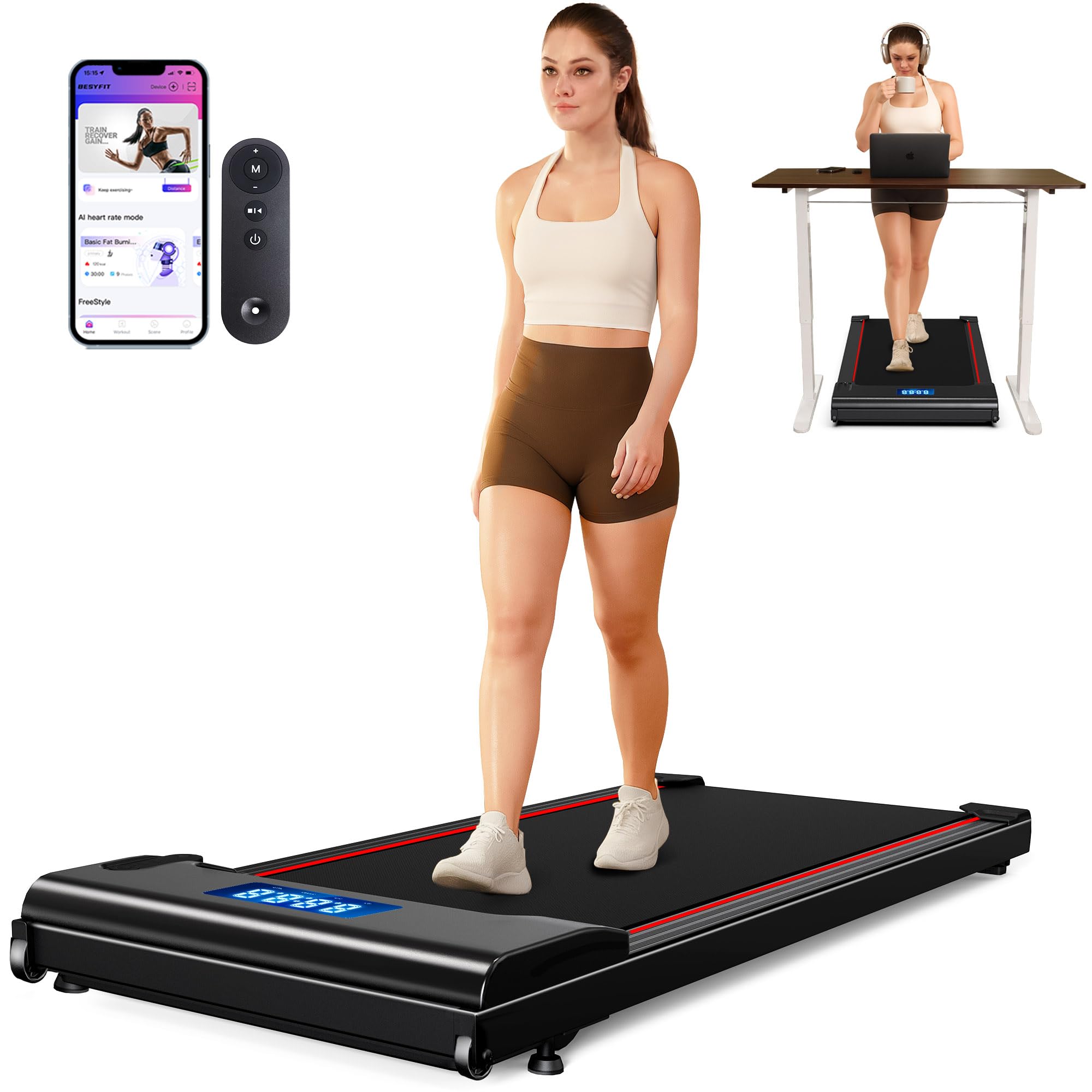
A walking pad is a treadmill with the running taken out: no console tower, a short flat deck, a top speed around a brisk walk, and a profile slim enough to slide under a sofa or a standing desk. That makes them cheap, quiet and easy to live with — and it means the differences between them are small numbers on a spec sheet that are easy to miss.
This guide covers what those numbers mean, the models worth shortlisting, and the point at which a full folding treadmill is the better buy. It is built from manufacturer specifications and current listings, not a lab test; where a figure is the maker’s rating, it says so.
The short version
- Walking while you work, app and remote included: the UREVO Spacewalk E4W — 0.5 to 4 mph, rated to 265 lb.
- You want incline, or need a higher weight rating: the Superun walking pad with 6% incline — 2.5 HP, rated to 300 lb.
- You want to walk at the desk and jog after work: a 2-in-1 with a fold-up handle, such as the UREVO Strol 2E.
- You actually want to run: skip walking pads. Look at a folding treadmill such as the NordicTrack T 6.5 or the NordicTrack Commercial 1750.
Five things to check
1. Weight capacity — with margin. Ratings on walking pads run from about 220 lb to 350 lb. Buy at least 20 percent above your bodyweight: a motor and deck working at their limit are louder, hotter and shorter-lived.
2. Top speed, honestly. Most pads stop at 4 mph — a fast walk. Units that advertise 6 or 7 mph are for light jogging at most, on a deck shorter than a real treadmill’s. If you run, a walking pad is the wrong tool.
3. Deck length versus your stride. This is the most common complaint in every listing: taller users find the belt short. Few makers publish belt dimensions prominently, so find the number on the listing and compare it with your stride before you order — especially if you are over six feet.
4. Incline. A fixed or manual incline of a few percent raises the workload noticeably at walking speed without any more noise. On most pads it is set by hand and the range is small; do not expect a treadmill’s powered 10 to 15 percent.
5. Handle, remote and app. A pad with no handle is fine under a desk you can hold onto, and a poor choice for anyone unsteady on their feet. Most are controlled by a small remote; app connectivity is a bonus on the branded models and absent on many unbranded ones.
Walking pads compared
| Model | Type | Speed | Incline | Maker’s weight rating | Controls |
|---|---|---|---|---|---|
| UREVO Spacewalk E4W | Walking pad | 0.5–4 mph | None listed | 265 lb | Remote and Bluetooth app |
| Superun, 6% incline | Under-desk pad, 2.5 HP | See listing | 6% | 300 lb | Remote, app, LED display |
| UREVO Strol 2E | 2-in-1: pad plus folding handle | Walking and jogging; see listing | None listed | See listing | App, dual display, safety handle |
| Unbranded 3.0 HP pad with handle bar | Walking pad with handle | 0.6–7.6 mph | Adjustable | 350 lb | On-deck display; no app |
| NordicTrack T 6.5 | Folding treadmill, 2.6 CHP | 0–10 mph | 0–10%, powered | 300 lb | 5″ display; iFit (subscription) |
| NordicTrack Commercial 1750 | Folding treadmill, 3.75 CHP | 0–12 mph | -3% to 15%, powered | See listing | 10″ touchscreen; iFit (subscription) |
Figures are the manufacturers’ own. “See listing” means the maker’s page should be checked for the current number; models are revised without being renamed.
For walking at a desk: UREVO Spacewalk E4W
The Spacewalk E4W is the straightforward choice from an established walking-pad brand: 0.5 to 4 mph, a 265 lb rating, a remote, and a companion app that logs your sessions. It folds and stores flat. It has no handle and no incline, and the deck will feel short to taller walkers — which is true of almost every pad in this class.
For more workload: Superun with 6% incline
The Superun adds a 6 percent incline and a 300 lb rating on a 2.5 HP motor, with remote and app control. Incline is the cheapest way to make a walk harder without going faster, so it suits anyone using the pad for fitness rather than just step count. The incline range is small and it is still a walking machine.
For walking and jogging: UREVO Strol 2E
The Strol 2E is a 2-in-1: handle down, it is an under-desk pad; handle up, it becomes a compact jogging treadmill with a safety rail and a dual display. It is the one to look at if two people with different goals share it. The published specifications are thin — check the listing for speed range, capacity and belt size before buying.
A word on unbranded pads
Marketplaces are full of near-identical walking pads sold under names that change every few months, often with impressive numbers — 3.0 HP, 7.6 mph, 350 lb. Some are fine. But a unit with no brand has no parts supply and, in practice, no warranty you can use. If you go that way, favour listings with a long review history, read the recent one-star reviews for belt-tracking and motor-failure complaints, and keep the box until you are sure.
When to buy a real treadmill instead
If you want to run, do intervals, or train on steep incline, buy a treadmill. The NordicTrack T 6.5 is the entry point — 10 mph, 10 percent powered incline, a 20 by 55 inch belt, 300 lb rating, and a frame that folds up. The Commercial 1750 is the step up: 12 mph, -3 to 15 percent incline, a 22 by 60 inch belt and a 10 inch touchscreen. Both lean on an iFit subscription for their best features, both are heavy, and both need two people to assemble. For how a treadmill compares with a rower or an air bike, see our cardio machine comparison.
Use it safely
- Place it on a flat, hard surface with clear space behind the belt. A mat protects the floor and cuts noise — see our flooring guide.
- Follow the manual’s start procedure. On most pads that means standing on the side rails, starting the belt at its slowest speed, then stepping on.
- Lubricate and re-centre the belt on the schedule in the manual. Most early failures are maintenance, not defects.
- Keep children and pets away from a moving belt, and unplug the pad when it is stored.
- If you have a heart, joint or balance condition, talk to your doctor first, and choose a model with a handle.
FAQ
Can you run on a walking pad?
Not really. Most top out around 4 mph, and the decks are shorter than a running stride needs. Models that reach 6 to 7 mph are for light jogging. For regular running, buy a treadmill.
Are walking pads loud?
At walking speed the motor is usually quieter than your footsteps. What neighbours hear is impact through the floor, so a mat matters more than the motor, and socks or soft shoes help.
What weight capacity do I need?
At least 20 percent above your bodyweight. A pad used near its limit runs hotter and wears faster.
Do I need an app?
No. It is convenient for logging steps and distance, but the remote does everything that matters. Many unbranded pads have no app at all.
How we chose
This guide compares manufacturer specifications and the drawbacks owners most often report, and sorts the machines by the job they suit. It is not a hands-on test, and nothing here is ranked by commission — see our affiliate disclosure. Prices change weekly, so none are quoted. Planning the rest of the room? Start with the complete home gym setup guide.