
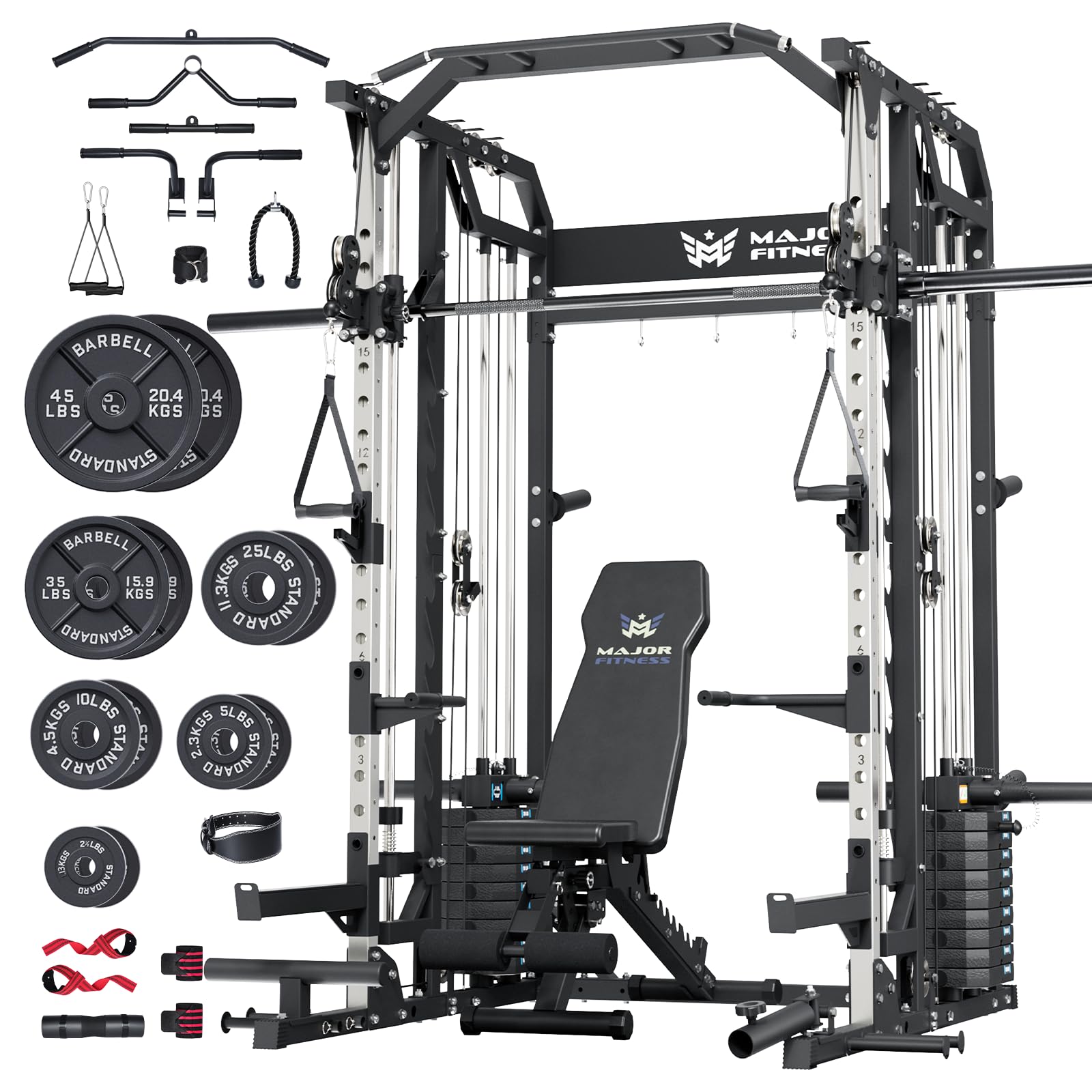
“Home gym machine” covers at least four different things, and they solve different problems. A stack gym has its own weights built in. A plate-loaded all-in-one combines a rack, a Smith machine and cables, and uses the plates you already own. A functional trainer is a pair of adjustable cable pulleys. And an incline bodyweight trainer uses you as the resistance. Most buying regret comes from choosing the wrong type, not the wrong brand.
This guide sorts the options by type, then lists the models worth a look in each, with the numbers that matter for a small space. It is built from manufacturer specifications and current listings rather than a gym-floor test; where a figure is the maker’s own rating, it says so. If you are still deciding between machines and free weights at all, start with free weights vs. home gym systems.
The short version
- You want to train tomorrow, own no plates, and have one corner: a stack gym — the Marcy MWM-989 (150 lb stack) or the Fitvids multifunction gym (160 lb stack, with a leg press).
- You lift heavy and want one footprint for everything: a plate-loaded all-in-one — the Force USA G20 or the Major Fitness B52.
- You already own a 3×3″ rack: bolt cables onto it with the REP Ares 2.0 attachment instead of buying a second machine.
- You have a wall and almost no floor: a wall-mounted cable station.
- You want low-impact, fold-away training: a Total Gym incline trainer.
- Whatever you choose, you need a bench: the REP AB-5200, or the OPPSDECOR 6-in-1 if the budget is tight.
Four questions that decide it
1. How strong are you now — and in two years? A 150–160 lb stack is plenty for a beginner and for most upper-body work, and a real ceiling on rows, pulldowns and presses for anyone who has trained for a while. Every stack gym in this guide lists “not enough for advanced lifters” among its drawbacks. Plate-loaded machines have no such ceiling; you just buy more plates.
2. Do you already own plates and a bar? If yes, a plate-loaded all-in-one or a rack attachment uses them. If no, price the plates in: a machine that “supports 1,000 lb” arrives with none.
3. What does your space really allow? Measure floor and ceiling, and add working room: you need to load a bar from the side and lie on a bench in front. Several listings here describe a “compact footprint” without giving numbers — get the dimensions from the current listing before you order. Our guide to home gyms under 100 square feet has layouts.
4. Who is assembling it? Every all-in-one and stack gym below lists slow, two-person assembly as a drawback. Budget an afternoon and a helper.
The machines compared
| Model | Type | Resistance | Maker’s capacity | Known drawbacks |
|---|---|---|---|---|
| Marcy MWM-989 | Stack gym | 150 lb stack | 150 lb | Stack limits advanced lifters; slow assembly; some plastic parts |
| Fitvids multifunction gym | Stack gym with leg press | 160 lb stack | 160 lb | Stack limits advanced lifters; two-person assembly |
| Force USA G20 | All-in-one: rack, Smith, cables, leg press | Plates | Rated to 1,000 lb | Large footprint; complex assembly; price |
| Major Fitness B52 | All-in-one: rack, Smith, cable crossover | Plates | Rated to 800 lb | Large footprint; two-person assembly; price |
| REP Ares 2.0 attachment | Functional trainer for a 3×3″ rack | Plates | 300 lb per side | Fits 3×3″ uprights only; no stacks included |
| Wall-mount cable station | Cable machine, 16 positions | Plates | Listed at 300 lb | Must be anchored into structure; not self-contained |
| Total Gym | Incline bodyweight trainer | Bodyweight | Users to 400 lb | Resistance capped by your bodyweight; learning curve |
| REP AB-5200 | Adjustable bench | — | Rated to 1,000 lb | Heavy; priced above entry-level benches |
| OPPSDECOR 6-in-1 | Bench with squat stands | — | About 600 lb, user plus load | Not for heavy barbell work; tight for tall lifters |
Capacities are the manufacturers’ own ratings. Check dimensions and the current listing before buying; models are revised without being renamed.
Stack gyms: Marcy MWM-989 and Fitvids
A stack gym is the closest thing to a commercial-gym machine circuit at home: pick a pin, change the weight in a second, no plates on the floor. The Marcy MWM-989 gives you a lat pulldown, pec deck, chest press and leg developer on a 150 lb stack, with an adjustable seat and backrest. The Fitvids multifunction gym adds a leg press and a slightly heavier 160 lb stack. Choose one if you are starting out, sharing the gym with family, or want quick circuits. Skip it if you already row or press more than the stack — you will outgrow it.
Plate-loaded all-in-ones: Force USA G20 and Major Fitness B52
These combine a power rack, a Smith machine and cable pulleys in one frame, so a barbell squat, a guided press and a cable fly all happen in the same footprint. The Force USA G20 is the fuller package — it adds a leg press and is rated to 1,000 lb, with safety catches and spotter arms. The Major Fitness B52 covers the same three jobs with an 800 lb rating, a lat pulldown and low row, and plate storage on the frame. Choose one if you train with a barbell and want cables without a second machine. Know first: “one footprint” is still a large one, and both take most of a day to build. We compare this category in depth in the best all-in-one power rack systems.
Already own a rack? REP Ares 2.0
The Ares 2.0 is not a machine but an attachment: dual adjustable pulleys, 24 to 84 inches, that bolt to a rack with 3×3″ uprights and load with your plates, up to 300 lb a side. It turns a rack you own into a functional trainer without taking any more floor. It will not fit other upright sizes, and it ships without weight stacks. Our full write-up is in the REP Ares 2.0 review.
No floor space: a wall-mounted cable station
A wall-mounted pulley station with 16 cable positions gives you pulldowns, rows, crossovers and face pulls from a few inches of wall. It is plate-loaded and unbranded, so read the listing carefully. The non-negotiable: it must be anchored into studs or masonry exactly as the instructions specify. A loaded cable pulls on its mounts with every rep; drywall anchors are not enough.
Low impact, folds away: Total Gym
A Total Gym is a padded board that slides on an inclined rail; you pull yourself up it with cables, and the steeper the incline, the harder it gets. It is rated for users up to 400 lb, weighs about 50 lb and folds for storage. It suits rehab-style, high-rep and mobility work very well, and it cannot load you past a share of your own bodyweight — it is not a strength-ceiling tool.
The bench underneath it all: REP AB-5200 and OPPSDECOR 6-in-1
The REP AB-5200 is rated to 1,000 lb, with seven back angles from flat to 85 degrees, three seat positions, and wheels to move it. It is heavy and not cheap, which is the point: a bench that wobbles under a heavy press is the wrong place to save money. The OPPSDECOR 6-in-1 bundles a bench, squat stands, leg developer and preacher pad at around 600 lb total capacity — a sensible starter, not a platform for heavy barbell work, and tight for taller lifters.
Set it up safely
- Assemble exactly as the manual specifies, re-torque every bolt after the first week, and check cables and pulleys for wear monthly.
- Respect the rated capacity. It includes you, the bar and the plates.
- Anchor anything the manual says to anchor — racks to the floor, wall stations into structure.
- Check that your floor can take the load. A loaded all-in-one on an upstairs floor is a question for someone qualified. Flooring options are in our home gym flooring guide.
- Talk to a doctor before starting a new programme, particularly with a health condition or an old injury.
FAQ
Is a 150 lb weight stack enough?
For a beginner, for most upper-body isolation work and for a family gym, yes. For an experienced lifter’s rows, pulldowns and leg work, no — that is the most common complaint about stack gyms, and the reason to look at plate-loaded machines instead.
All-in-one machine or a power rack with attachments?
If you own nothing, an all-in-one is simpler and usually cheaper than buying the pieces. If you already own a good rack, an attachment such as the Ares 2.0 adds cables for far less money and no extra floor space.
How much space does an all-in-one gym need?
More than the frame. Allow room to load a seven-foot bar from both sides and to set a bench in front, plus ceiling height for pull-ups and overhead work. Take the frame dimensions from the listing and add about three feet on the working sides.
Can I build a home gym without any machine?
Yes — a bench and adjustable dumbbells cover a great deal. See our adjustable vs. fixed dumbbells guide and the complete home gym setup guide.
How we chose
This guide compares manufacturer specifications, rated capacities and the drawbacks owners most often report, and sorts the machines by the job they suit. It is not a hands-on test, and nothing here is ranked by commission — see our affiliate disclosure. Prices change weekly, so none are quoted.