
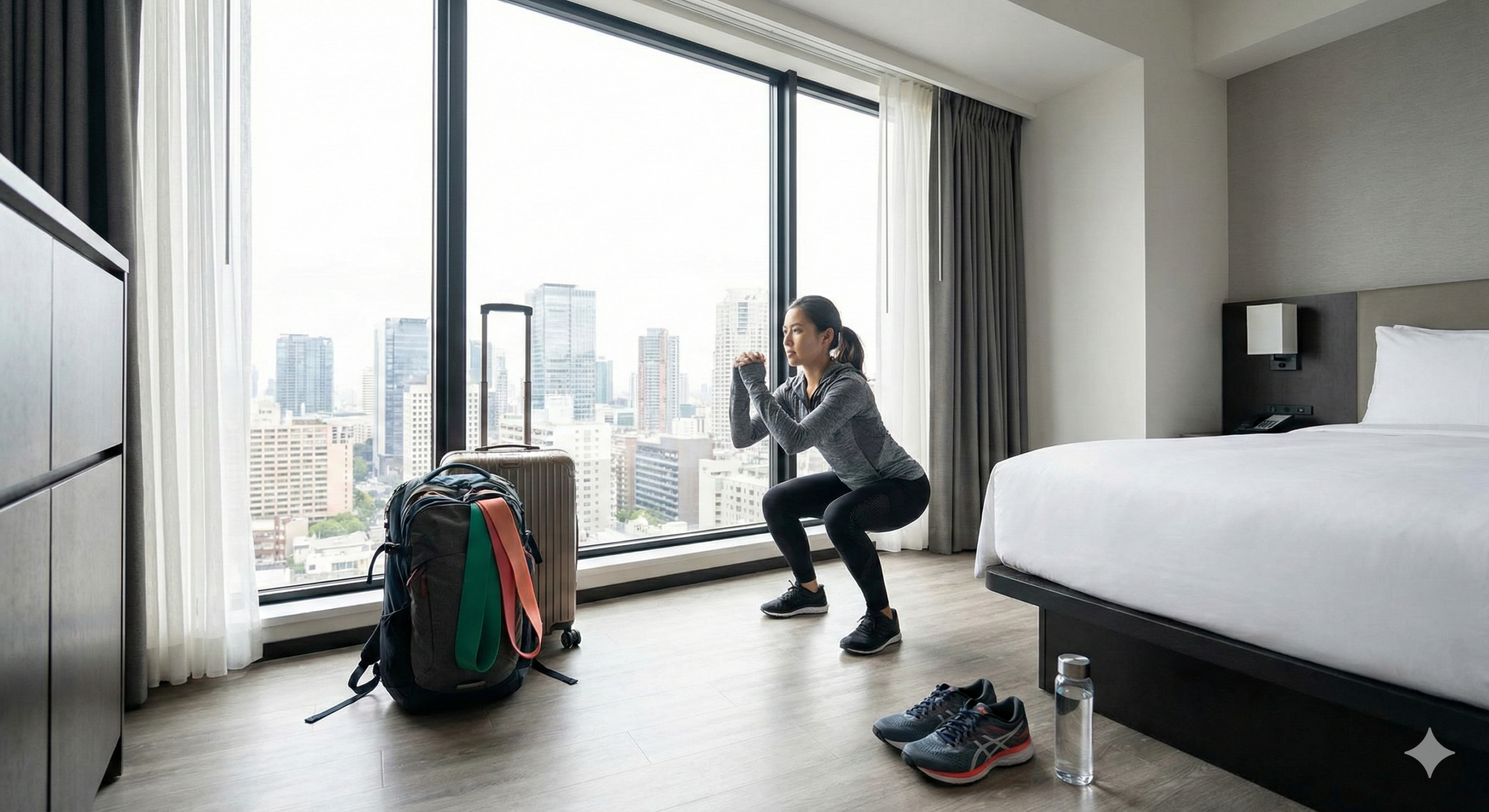
Travel is the silent killer of fitness progress. You spend months building a routine in your home gym, dialing in your nutrition, and hitting PRs, only to have a 5-day business trip or a two-week vacation derail everything.
The reality for many of us—especially those balancing executive roles with family life—is that travel is inevitable. But falling off the wagon doesn’t have to be.
Whether you are a VP jumping between client dinners and boardrooms, or a parent trying to squeeze in a lift before the family wakes up at Disney, maintaining your fitness on the road requires a shift in mindset. You stop looking for the “perfect” workout and start looking for the effective one.
This is your comprehensive guide to training while traveling. We will cover how to train with (and without) a gym, how to pack efficiently using a one-bag philosophy, and the specific gear that makes mobile fitness possible.
Part 1: The Mindset of the Working out While Traveling
Before we talk about gear or reps, we need to address the schedule. The number one excuse for skipping workouts on the road is “I didn’t have time.”
When you are traveling for work, your schedule is not your own. You have early starts, late dinners, and jet lag. The key is to stop treating your workout as a leisure activity and start treating it like a meeting.
1. The “First Thing” Rule
If you don’t do it before breakfast, it probably won’t happen. Client dinners run late, and by 6:00 PM, your motivation will be zero. Wake up 45 minutes earlier than you need to. Get the sweat in before you check your email.
2. Frequency Over Duration
At home, you might do 60–90 minute sessions. On the road, aim for 20–30 minutes. High intensity, low rest. The goal is maintenance and metabolic stimulus, not necessarily hitting a new 1RM (one-rep max).
3. Adaptability
If the hotel gym is a closet with a broken treadmill and 5lb dumbbells, you don’t skip the workout. You pivot to bodyweight volume or use the resistance bands you packed (more on that later).
Part 2: Scenario A – You Have Access to a Hotel Gym
Hotel gyms are a mixed bag. Sometimes you get a fully decked-out facility with Technogym equipment; other times, it’s a room that smells like chlorine with one rusty elliptical.
The Strategy: Stick to the “Big Rocks”
If you are lucky enough to have dumbbells up to 50lbs and a functional adjustable bench, you can replicate 80% of your home gym routine.
The “Hotel Dumbbell” Full Body Split Perform this circuit 3–4 times with 60 seconds rest between rounds.
- Goblet Squats (15 reps): Hold the heaviest dumbbell available at chest height. Focus on depth and tempo since the weight will likely be lighter than you’re used to.
- Dumbbell RDLs (12 reps): Keep the tension on the hamstrings. If the weight is light, switch to Single-Leg RDLs.
- Dumbbell Chest Press or Floor Press (12 reps): If there’s no bench, the floor press is safer for your shoulders and limits range of motion to focus on triceps/chest.
- Single-Arm Rows (12 reps per side): Use the weight rack or a bench for support.
- Dumbbell Thrusters (10 reps): A metabolic finisher that torches shoulders and legs.
The “Cardio Equipment” Pivot
If the gym only has cardio machines, don’t just jog for 30 minutes. Use the treadmill for intervals or a “deadmill” push (turn the treadmill off and push the belt with your legs for 30 seconds on, 30 seconds off) to simulate a sled push.
Part 3: Scenario B – The “No Gym” Reality
This is where most people fail. You arrive at the Airbnb, or the hotel gym is “under renovation.”
You do not need iron to build muscle. You need tension. If you have gravity and perhaps one piece of travel gear, you are set.
The Hotel Room Grind (Bodyweight Only)
This workout requires zero equipment and roughly the space of a yoga mat.
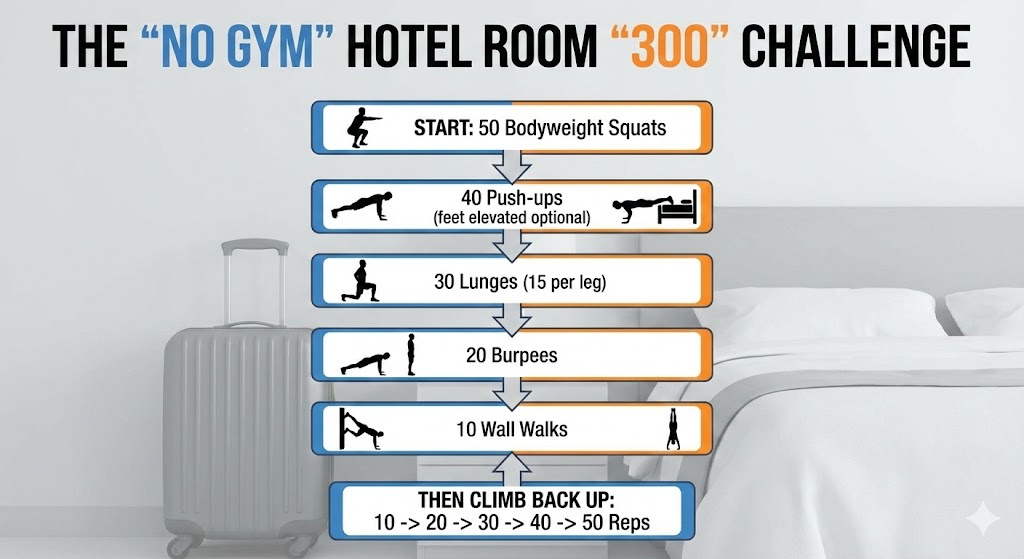
The “300” Hotel Room Challenge Complete for time:
- 50 Bodyweight Squats
- 40 Push-ups (feet elevated on the bed for increased difficulty)
- 30 Lunges (per leg)
- 20 Burpees
- 10 Wall Walks (walk your feet up the wall into a handstand position)
- …and then work your way back up the list (10, 20, 30, 40, 50).
Utilizing the Environment
- Chairs: Use for dips or elevated split squats (Bulgarian Split Squats).
- Doorframe: Isometric holds. Push against the frame as hard as you can for 30 seconds to activate the chest and shoulders.
- Luggage: Your carry-on is a weight. If you packed efficiently, it probably weighs 20–30lbs. Use it for rows, overhead presses, or hug it for squats.
Part 4: The Gear – What to Pack
If you subscribe to the one-bag travel philosophy, space is premium. You cannot bring a chaotic mess of equipment. You need high-ROI (Return on Investment) tools that take up minimal space.
1. The Essentials (Carry-On Friendly)
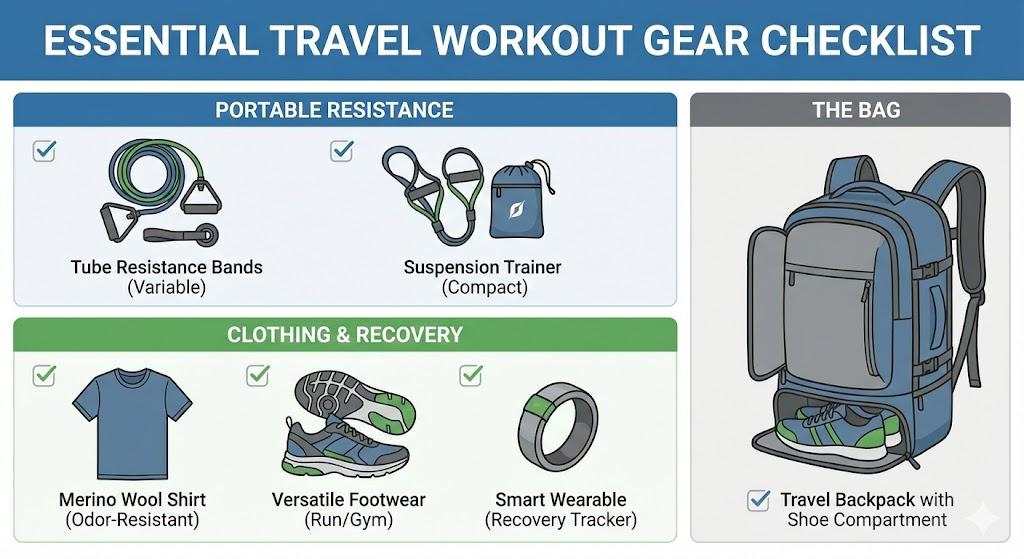
- Resistance Bands (Tube Style):
- Why: They weigh nothing and offer variable resistance.
- Recommendation: Rogue Tube Bands. Unlike the cheap Amazon sets that snap, Rogue’s bands are durable and come with legitimate handles. You can anchor them to a hotel door knob for chest flys, tricep press-downs, and face pulls.
- Suspension Trainer:
- Why: The gold standard for bodyweight training. It allows you to do pull movements (rows, curls) which are almost impossible to do with just gravity.
- Recommendation: TRX GO Suspension Trainer. It’s the lighter, travel-specific version. It packs down to the size of a rolled-up t-shirt.
- The “Smart” Wearable:
- Why: Travel destroys sleep. Monitoring your recovery is more important on the road than at home.
- Recommendation: Oura Ring or Whoop. It’s discreet, doesn’t need to be taken off for security, and tracks how that 5-hour flight affected your HRV.
2. Clothing & Footwear
- Merino Wool:
- If you are traveling for a week, you don’t want to pack 5 gym outfits. Merino wool (like shirts from Unbound Merino or Smartwool) is naturally antimicrobial. You can sweat in it, let it dry, and wear it again the next day without it smelling.
- Versatile Footwear:
- Don’t pack separate “gym shoes” and “walking shoes.” Bring a pair that does both.
- Recommendation: New Balance Fresh Foam series. They look clean enough for “travel casual” but are high-performance enough for a 5k run or a hotel gym session.
3. The Bag
- You need a bag that organizes tech and gear separately. The Aer Travel Pack 3 is a standout here. It has a ventilated shoe compartment (crucial for keeping gym shoes away from your laptop) and enough volume to hold your TRX and bands without crushing your dress shirts.
Part 5: Finding Time in a Busy Schedule
The “I’m too busy” excuse is usually a scheduling error, not a time shortage.
The Calendar Block
Treat your workout like a client call. Put it in your Google Calendar. If it’s not on the calendar, it doesn’t exist.
- Strategy: Block out 6:00 AM – 7:00 AM as “Personal Development.” Most colleagues won’t book over that.
The “Dead Time” Workout
Airports are full of dead time. If you have a 2-hour layover:
- Walk: Don’t sit at the gate. Walk the terminal. A fast-paced walk with a heavy backpack is basically rucking.
- Stretch: Find a quiet corner (or a yoga room, which many hubs like SFO and ORD now have) and do 10 minutes of mobility work to undo the damage of the economy seat.
Part 6: Extended Trips (Overseas & Long Haul)
When you are gone for more than 7 days, or crossing multiple time zones (like a trip to India or Europe), maintenance mode isn’t enough. You need a sustainable routine.
1. Day Passes & Local Gyms
Hotel gyms get depressing after day 3. Use apps like ClassPass or simply Google “Powerlifting gym near me” or “CrossFit box near me.”
- Tip: Local “hardcore” gyms usually sell day passes for $15–$20. It’s worth it for the atmosphere alone, and it gets you out of the hotel bubble.
2. Nutrition Control
Long trips mean eating out. The “vacation diet” will wreck you over two weeks.
- Grocery Store Run: The first thing you do upon arrival is find a local grocery store. Buy:
- Water (gallons).
- Protein (jerky, Greek yogurt, whey protein powder).
- Fruit/Veg (apples, carrots).
- Breakfast Rule: Control breakfast. Eat protein and fats in your room (using your grocery stash). Save your “eating out” calories for lunch and dinner meetings.
3. Fighting Jet Lag with Exercise
Light exercise is one of the best ways to reset your circadian rhythm.
- Arrival Day: Do not nap. Go for a walk outside in the sunlight immediately. Do a light, 20-minute bodyweight circuit to get the blood moving. This signals to your body that it is daytime.
Part 7: Additional Travel Tips & Hacks
- Hydration: Flying dehydrates you. Most fatigue on the road is actually dehydration. Bring a collapsible water bottle or just buy the biggest bottle you can find at the airport newsstand.
- Download Offline Content: Hotel Wi-Fi is notoriously bad in gym basements. Download your Spotify playlists and your workout videos (if you use an app like Peloton or Apple Fitness+) before you leave home.
- Road Trip Advantage: If you are driving (say, taking the truck out for a domestic trip), you have no gear restrictions. Throw a pair of adjustable dumbbells (like Nuobells) or a kettlebell in the bed of the truck. You now have a mobile gym anywhere you park.
Part 8: Frequently Asked Questions (FAQ)
Q: Can I bring resistance bands and a TRX in my carry-on? A: Yes. TSA generally allows resistance bands and suspension trainers. However, avoid bringing heavy metal carabiners that look like weapons. The standard TRX hardware is fine.
Q: I have zero time. Is 15 minutes really enough? A: Yes. If the intensity is high. A 15-minute AMRAP (As Many Rounds As Possible) of burpees, squats, and pushups will do more for your metabolism than a 60-minute low-effort walk.
Q: How do I deal with workout clothes that smell in my suitcase? A: Use a “dry bag” (like the ones used for kayaking) or a dedicated antimicrobial laundry bag. Also, wash your clothes in the hotel sink with a little shampoo if you’re desperate, and hang them to dry overnight. Merino wool helps avoid this problem entirely.
Q: Should I bring protein powder? A: If you are picky about brand, yes. Put a few scoops in a Ziploc bag or small Tupperware. Don’t bring a tub of white powder without labeling it, or you might have an interesting conversation with customs.
Part 9: Product Recommendations Summary
- Best Resistance Bands: Rogue Tube Bands (Durability and handle quality).
- Best Suspension System: TRX GO (Lightweight, packs small).
- Best Travel Backpack: Aer Travel Pack 3 (Organization, shoe pocket).
- Best Recovery Tracker: Oura Ring (Sleep and HRV tracking).
- Best Travel Shoe: New Balance Fresh Foam (Running and casual crossover).
- Best for Road Trips: Nuobell Adjustable Dumbbells (Compact but heavy duty).
The Bottom Line
You don’t need a squat rack to stay fit. You need discipline and a plan. The “perfect” workout is the one you actually do. Pack your bands, set your alarm, and treat your health with the same professional respect you treat your career.
Safe travels, and keep grinding.