
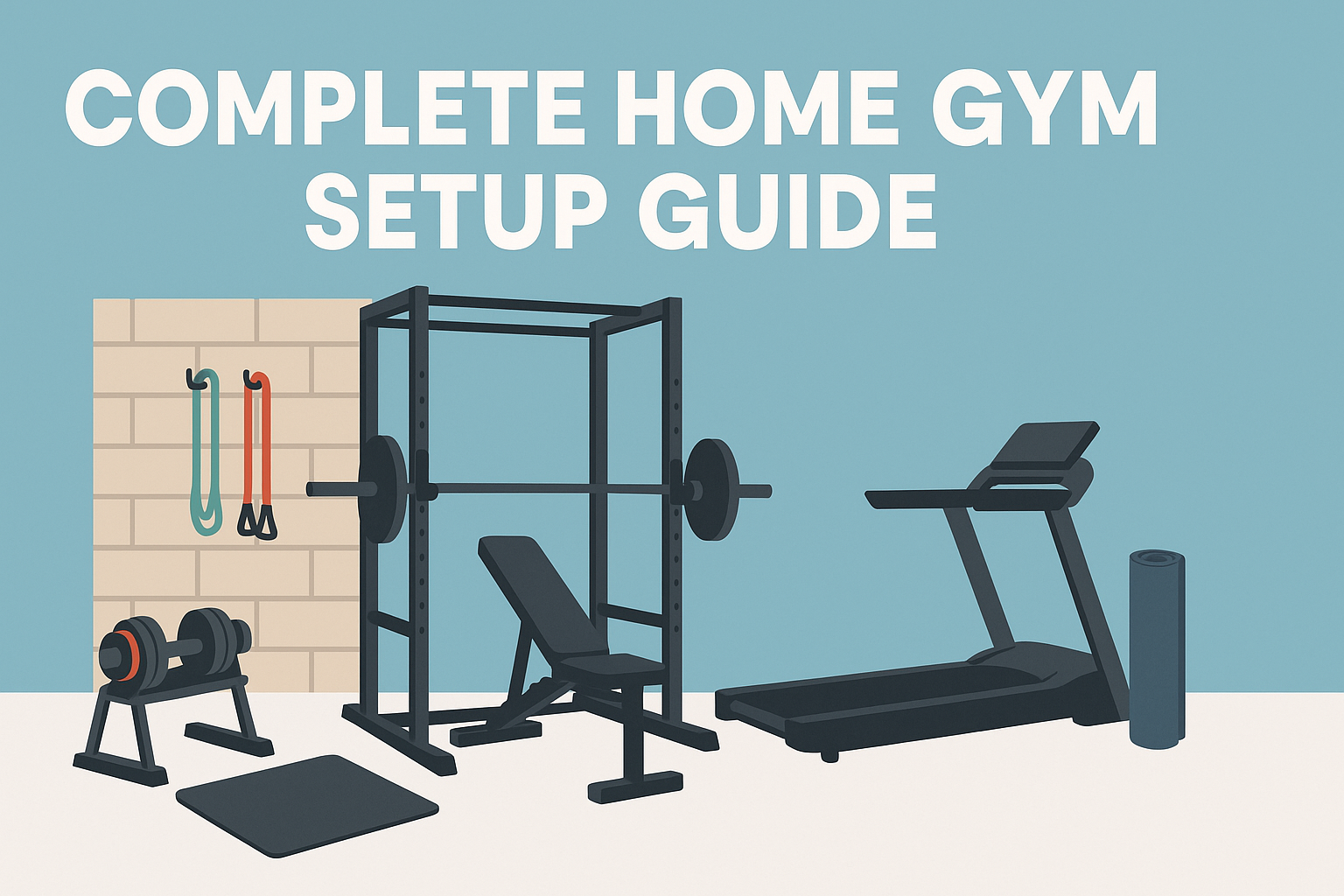
Complete Home Gym Setup Guide – From Small Apartment to Full Garage: How to Choose Equipment, Layout & Budget
Note: Some links below are affiliate links. As an Amazon Associate, Everyday Home Gym may earn from qualifying purchases at no additional cost to you.
Building a home gym is one of the highest-ROI investments you can make for your health, time, and sanity. No commute, no waiting for equipment, no gym crowd at 6 p.m.—just you, your goals, and a space that works exactly the way you want.
You also have more company than ever. The home fitness equipment market in the U.S. is worth billions of dollars and is projected to keep growing through 2030 as people stick with hybrid and at-home training.
The problem? Setting up a home gym can feel overwhelming:
- What equipment do I really need?
- How do I fit this into a tiny apartment… or a cluttered garage?
- How much should I actually spend?
This guide walks you step-by-step through a complete home gym setup, from small apartment corner to full garage gym, including:
- How to choose the right equipment for your goals
- How to plan your layout for any size space
- Budget tiers (starter, builder, and dream setups)
- Specific Amazon product recommendations with your affiliate tag
Step 1: Get Clear on Your Goals (Before You Buy Anything)
Your training goal should drive your equipment list and layout—not the other way around.
Most home gym buyers fall into one (or a mix) of these buckets:
General fitness & weight loss
- Goal: move more, drop body fat, feel better
- Focus: daily activity, basic strength, cardio consistency
Strength & muscle gain
- Goal: get stronger, build muscle, progressive overload
- Focus: dumbbells/barbells, power rack, bench, high-quality resistance
Athletic performance / endurance
- Goal: perform better in a sport (cycling, MTB, running, etc.)
- Focus: conditioning tools (treadmill, rower, bike), plus strength work
Longevity & mobility
- Goal: stay mobile, pain-free, strong as you age
- Focus: lighter resistance, bands, bodyweight work, safe progression
Take 2 minutes and write down:
- Your primary goal (e.g., “Build muscle and lose 10–15 lbs”)
- Training frequency (e.g., “3–4 days per week”)
- Style you enjoy (lifting, circuits, walking/running, etc.)
You’ll use this as a filter when you start choosing equipment.
Step 2: Measure Your Space (Apartment Corner → Full Garage)
A home gym can live in:
- A 6′ x 4′ corner of your living room
- A closet or office with a foldable bench and adjustable dumbbells
- A 10′ x 10′ spare bedroom
- A single-car garage (12′ x 20′ is common)
- A two-car garage bay or unfinished basement
Key measurements to grab
Floor space:
- Width x length in feet
- Subtract space needed for doors to open, closet access, etc.
Ceiling height:
- Critical if you want a power rack or to do overhead press & pull-ups
- Most racks list max height and pull-up bar height in their specs
Flooring type:
- Concrete, carpet, hardwood, vinyl
Noise constraints:
- Upstairs apartment vs. ground floor
- Shared walls with bedrooms / neighbors
Rule of thumb:
- For a compact “strength + cardio” setup, aim for 6–8 feet of width and 8–10 feet of length.
- For a full garage gym with rack, bench, and cardio, you’ll be happier with 10–12 feet width and 16–20 feet length.
Step 3: Set a Realistic Budget (and Phased Plan)
You don’t need to buy everything at once. In fact, most great home gyms are built in layers over months or years.
Budget Tiers (Equipment Only, Not Including Room Renovation)
| Tier | Budget Range | Ideal For | Core Focus |
|---|---|---|---|
| Starter | Under $500 | Apartment & beginners | Bands, adjustable dumbbells, bench, mat |
| Builder | $500–$1,500 | Most home owners | Add rack, barbell, more weight, compact cardio |
| Dream | $1,500–$4,000+ | Full garage setups | Heavy rack, high-end cardio, specialty equipment |
We’ll plug actual sample builds into these tiers in a minute.
Step 4: Equipment Priorities – The “Big 4” Framework
To keep things simple, think of your home gym in four buckets:
- Primary resistance (what makes you stronger)
- Cardio / conditioning
- Support & safety (bench, rack, flooring)
- Comfort & recovery (mats, mobility tools)
1. Primary Resistance: Build Strength in Any Space
Option A: Adjustable Dumbbells (Best for Apartments & Small Rooms)
- Huge weight range in a tiny footprint
- Perfect for presses, rows, goblet squats, lunges, RDLs, curls, and more
- Often cheaper (and WAY more space-efficient) than a full set of fixed dumbbells
Example adjustable dumbbells on Amazon:
15-in-1 Adjustable Dumbbells (pair, 52.5 lb each) – quick one-hand dial system, 15 weight settings per dumbbell, ideal for full-body training:
👉 https://www.amazon.com/Adjustable-Dumbbells-Set%EF%BC%8CAdjustable-Dumbbell-Equipment/dp/B0FPFHV183?tag=evrydayhomegym-20
These pair well with a foldable bench or even just a sturdy chair if space is tight.
Option B: Power Rack + Barbell (Best for Garages & Bigger Spaces)
Once you have the space and budget, a rack + barbell setup unlocks heavy squats, bench, deadlifts, overhead press, and pull-ups safely.
Example compact rack for home gyms:
RQR Power Rack with Pull-Up Bar – multi-function rack with squat stand, bench rack, dual-grip pull-up bar, plus dip attachment:
👉 https://www.amazon.com/RQR-Adjustable-Heavy-Duty-14-Position-Attachment/dp/B0FHB5SYK1?tag=evrydayhomegym-20
You can start with dumbbells only and add a rack later when budget and space allow.
Option C: Resistance Bands (Ultra-Compact & Travel-Friendly)
Bands are perfect for starter setups and to add variety to more advanced gyms:
- Great for rows, presses, pull-apart, curls, triceps, and mobility work
- Easy to anchor to doors, racks, or sturdy posts
Example resistance band kit:
SmarterLife Resistance Bands Set with Handles & Door Anchor – includes multiple resistance levels, handles, ankle straps, and door anchor:
👉 https://www.amazon.com/Resistance-Exercise-Stretching-Strength-Men-Women/dp/B01LY9ES97?tag=evrydayhomegym-20
2. Cardio & Conditioning: Move More Without Leaving Home
You don’t need a big cardio machine, but for many people it makes consistency easier.
Best for Apartments: Compact Walking Pad or 3-in-1 Treadmill
Look for:
- Foldable design
- Low deck height
- Quiet motor (especially for upstairs units)
Example compact treadmill:
Sperax 3-in-1 Folding Treadmill / Walking Pad – under-desk capable, up to 2.5 HP, multiple modes for walking and running:
👉 https://www.amazon.com/Sperax-Treadmill-Walking-Treadmill-2-Treadmill-Treadmills-Home-Black/dp/B0BTXDKSVG?tag=evrydayhomegym-20
Alternatively, if space is really tight, you can combine:
- Brisk outdoor walks + bands + dumbbell circuits
…and skip the treadmill entirely at the beginning.
3. Support & Safety: Benches, Flooring, and Layout
Adjustable Bench (Huge Versatility per Square Foot)
An adjustable bench turns your dumbbells or barbell into a full upper-body training system: incline press, flat press, rows, seated curls, etc.
Example foldable adjustable bench:
BARWING Adjustable Weight Bench (700 lb rating) – multiple backrest positions, foldable, great for small home gyms:
👉 https://www.amazon.com/BARWING-Adjustable-Foldable-Incline-Assembly/dp/B0FH9RNYRY?tag=evrydayhomegym-20
Flooring
For garages or basements, use:
- 3/8″ or 1/2″ rubber stall mats (from farm supply or big-box stores), or
- Interlocking foam tiles (okay for light dumbbells, not ideal for heavy deadlifts)
Flooring protects your joints, your equipment, and your house resale value.
4. Comfort & Recovery: Where You Actually Want to Train
Little things make your home gym feel “real” and keep you consistent:
- Good lighting (bright, not dungeon-dark—unless you like that vibe)
- Fan or basic climate control (garage summers are brutal)
- A dedicated yoga / stretch mat
Example 10mm mat for stretching & floor work:
Gaiam Essentials 10mm Yoga & Exercise Mat – extra-thick cushion, includes carry strap:
👉 https://www.amazon.com/Gaiam-Essentials-Exercise-Easy-Cinch-Workouts/dp/B0FRG5TM2T?tag=evrydayhomegym-20
Step 5: Sample Home Gym Builds by Budget & Space
Let’s put it all together. Use these as templates you can tweak.
Build 1: Under-$500 “Anywhere” Home Gym (Apartment-Friendly)
Ideal for: studio apartments, bedrooms, small offices, or anyone just getting started.
Space needed: ~6′ x 4′ corner
Core equipment:
- Adjustable Dumbbells (52.5 lb pair)
👉 https://www.amazon.com/Adjustable-Dumbbells-Set%EF%BC%8CAdjustable-Dumbbell-Equipment/dp/B0FPFHV183?tag=evrydayhomegym-20 - Foldable Adjustable Bench
👉 https://www.amazon.com/BARWING-Adjustable-Foldable-Incline-Assembly/dp/B0FH9RNYRY?tag=evrydayhomegym-20 - Resistance Bands Set with Door Anchor
👉 https://www.amazon.com/Resistance-Exercise-Stretching-Strength-Men-Women/dp/B01LY9ES97?tag=evrydayhomegym-20 - 10mm Yoga / Exercise Mat
👉 https://www.amazon.com/Gaiam-Essentials-Exercise-Easy-Cinch-Workouts/dp/B0FRG5TM2T?tag=evrydayhomegym-20
What you can do with this setup:
- Full-body strength training (push, pull, legs, core)
- Hypertrophy workouts (3–4 days/week)
- Circuit-style conditioning
- Mobility & stretching sessions
This is an incredibly high-value, low-space build that will carry a beginner or intermediate lifter very far.
Build 2: $500–$1,500 “Builder” Home Gym (Spare Room or Small Garage)
Ideal for: homeowners with a dedicated room or half a garage.
Space needed: ~8′ x 10′ or larger
Add to Build 1:
- Compact Power Rack with Pull-Up Bar
👉 https://www.amazon.com/RQR-Adjustable-Heavy-Duty-14-Position-Attachment/dp/B0FHB5SYK1?tag=evrydayhomegym-20 - Olympic Barbell + Plates (choose set based on budget and strength level)
- Optional Compact Treadmill / Walking Pad
👉 https://www.amazon.com/Sperax-Treadmill-Walking-Treadmill-2-Treadmill-Treadmills-Home-Black/dp/B0BTXDKSVG?tag=evrydayhomegym-20 - Basic Rubber Flooring (3/8″ stall mats or similar)
Capabilities now:
- Heavy compound lifts: squats, bench, overhead press, deadlifts
- Pull-ups and dips (if your rack has dip attachment)
- Structured strength programs (5×5, push/pull/legs, upper/lower)
- Easy daily walking and light runs on the treadmill
For most people, this is the sweet spot of cost vs. capability.
Build 3: $1,500–$4,000+ Dream Garage Gym
Ideal for: single- or two-car garage, unfinished basement, or large spare room.
Take Build 2 and upgrade/add:
- Heavier-duty rack with cable attachment or separate pulley system
- Better barbell + more plates (including bumper plates if doing Olympic lifts)
- Higher-end treadmill, rower, or air bike
- Specialty tools:
- Trap bar / hex bar
- Adjustable kettlebell
- Plyo box
- GHR / reverse hyper (if space allows)
At this level, your garage gym can replace pretty much any commercial gym for strength & conditioning.
Step 6: Example Layouts – From Small Apartment to Full Garage
Layout 1: 6′ x 4′ Apartment Corner
- Bench folds and stores vertically behind a couch or against a wall
- Adjustable dumbbells on a small stand or low shelf
- Resistance bands + mat rolled up in a bin
Tips:
- Use vertical storage (hooks for bands, wall shelves)
- Train with quiet options in the early morning/late night (bands, slow tempo workouts, walking pad)
Layout 2: 10′ x 10′ Spare Room
Example arrangement:
- Place rack centered on the back wall
- Bench slides in/out of the rack
- Dumbbells & bands stored on one side
- Cardio machine (treadmill/bike) along a side wall
Clearances to maintain:
- 3 ft behind the barbell for safe walking
- 3–4 ft in front of the rack for squats and lunges
- Enough overhead room for press and pull-ups (check rack height vs. ceiling)
Layout 3: Single-Car Garage Gym
Common garage size: ~12′ x 20′ (varies by house).
Suggested flow:
- Rack Zone (back wall)
- Rack centered
- Plates on both sides
- Bench parked inside the rack
- Cardio Zone (side wall)
- Treadmill, rower, or bike
- Floor / Mobility Zone (front or corner)
- Mat for stretching, ab work, bodyweight movements
- Storage Zone (wall-mounted):
- Pegboard for bands, belts, collars
- Hooks for jump ropes, resistance bands
- Small shelves for chalk, timer, etc.
If you still park a car in the garage, choose folding racks and rolling cardio machines that can slide against the wall.
Step 7: What to Prioritize vs. What to Skip
Spend More On:
- Anything that holds you + heavy weight (rack, bench, barbell)
- Adjustable dumbbells (you’ll touch them every session)
- Flooring (protects both your body and your house)
Save Money On:
- Fancy accessories you’ll rarely use
- Overcomplicated “all-in-one” machines with lots of weak stations
- Duplicate tools (if you have bands and dumbbells, you may not need four specialty gadgets doing the same job)
Common Home Gym Mistakes
- Buying too much, too soon
Start with the basics and upgrade when you feel the bottleneck. - Ignoring ceiling height and door swings
Measure before buying a tall rack or treadmill with console. - No plan for storage
A messy gym is a gym you’ll skip. Build in shelves, hooks, and bins. - Skipping safety
Always use safeties on your rack and keep walkways clear of plates & dumbbells.
Step 8: How to Actually Use Your Home Gym (Simple Training Framework)
Once your home gym is set up, use a structure like this:
Example Weekly Split (3 Days/Week)
Day 1 – Full Body A
- Squat or goblet squat
- Bench or dumbbell press
- Dumbbell row or band row
- Core / carry
Day 2 – Conditioning + Mobility
- 20–30 min treadmill walk/jog
- Bands + bodyweight circuit
- 10 min stretching on the mat
Day 3 – Full Body B
- Deadlift or RDL
- Overhead press
- Pull-ups/band pulldowns
- Lunges or split squats
Add optional extra walking or cycling on off days.
Quick FAQ: Home Gym Setup
Do I need a power rack to have a “real” home gym?
No. A pair of adjustable dumbbells + bench + bands can deliver serious strength and muscle for years. A rack becomes important if you want heavy barbell squats, bench, and pull-ups.
How much space do I need for a home gym?
- Minimal setup: ~6′ x 4′ (corner)
- Small dedicated room: 8′ x 10′
- Full garage gym: 10′ x 16’+ is comfortable
Should I buy used equipment?
Absolutely—especially for racks, plates, and barbells. Just check for rust, bent parts, and damaged welds/knurling. New Amazon gear is great when you want convenience and fast shipping; used is great when you want to stretch the budget.
Is a treadmill worth it?
If you know you’ll walk more when it’s in the house, yes. Even a compact walking pad can be a game-changer for daily step counts and calorie burn, especially if you work from home.
Final Thoughts: Build the Gym That Fits Your Life
You don’t need a giant budget or a three-car garage to build a legit home gym.
If you:
- Get clear on your goals,
- Measure your space,
- Choose equipment using the Big 4 framework, and
- Build in phases (starter → builder → dream),
…you’ll end up with a setup that you actually use, not just look at.