
Reviewed by Robb Sutton
Last Updated: January 20, 2026
Latest Best Price – Speediance Gym Monster
1. The Smart Gym Revolution and the Speediance Proposition
The trajectory of home fitness has historically been defined by a binary choice: the tactile, immutable reality of iron plates, or the compromised convenience of resistance bands and flimsy bow-flexing rods. For decades, the serious strength athlete was effectively exiled to the garage, surrounded by power racks and dumbbells, while the casual user made do with equipment that prioritized storage over performance. This dichotomy was shattered with the advent of “digital weight”—a technological leap that replaced gravity with electromagnetism, allowing a motor to simulate the feeling of a barbell with terrifying precision.
Into this brave new world stepped the Speediance Gym Monster. It arrived not as the first of its kind—Tonal had already claimed the mantle of the “iPhone of fitness”—but as a philosophical counter-argument. Where the market leaders demanded wall installations and perpetual monthly rents in the form of mandatory subscriptions, Speediance proposed a different social contract: ownership. The Gym Monster promises a high-performance, freestanding, all-in-one gymnasium that functions right out of the box, without drilling into studs and, crucially, without a subscription tether.1
This report serves as the definitive, exhaustive analysis of the Speediance Gym Monster (encompassing the original, the 2, and the 2S iterations). It is written for the discerning fitness enthusiast who demands to know not just what the machine does, but how it does it, why it matters, and whether it can truly replace a commercial gym membership in 2026.
1.1 The Problem with Gravity
To understand the engineering marvel of the Gym Monster, one must first appreciate the limitations of gravity. In a traditional gym, resistance is vertical. To redirect that force, one needs massive pulleys, towering stacks of iron, and significant floor space. A 200-pound stack weighs 200 pounds whether you are lifting it or trying to move the machine to a new apartment. Gravity is heavy, cumbersome, and dumb. It does not know if you are struggling; it does not care if your form is breaking down.
The Speediance Gym Monster utilizes dual 800-watt Permanent Magnet Synchronous Motors (PMSM) to generate resistance.3 By manipulating the magnetic fields within these motors, the machine creates torque that pulls against the user. This “digital gravity” allows for a device that weighs less than 200 pounds to generate 220 pounds of resistance, occupy less than 4 square feet when folded, and provide advanced training modalities like eccentric overloading that are physically impossible with standard weights.3
1.2 Market Positioning: The “Anti-Subscription” Hero?
The central narrative of the Speediance marketing machine is the “Free Mode.” In an era where BMW charges a subscription for heated seats and Tonal renders its hardware useless without a $60/month fee, Speediance stands as a bastion of hardware sovereignty. The promise is simple: you buy the machine, you own the resistance. As we will explore in later sections, this “Free Mode” is not merely a demo mode but a fully featured training interface that allows for serious, unencumbered progression.2 This positioning has made the Gym Monster the darling of the “buy it for life” crowd and renters who cannot modify their living spaces for wall-mounted competitors.6
2. Design Language and Physical Architecture
The physical presence of the Speediance Gym Monster is a study in functional minimalism. Unlike the sleek, mirror-like aesthetic of the Tonal which attempts to disappear into a living room wall, the Gym Monster is unapologetically a piece of equipment, yet it manages a level of industrial elegance that fits within a modern home.
2.1 The Freestanding Form Factor
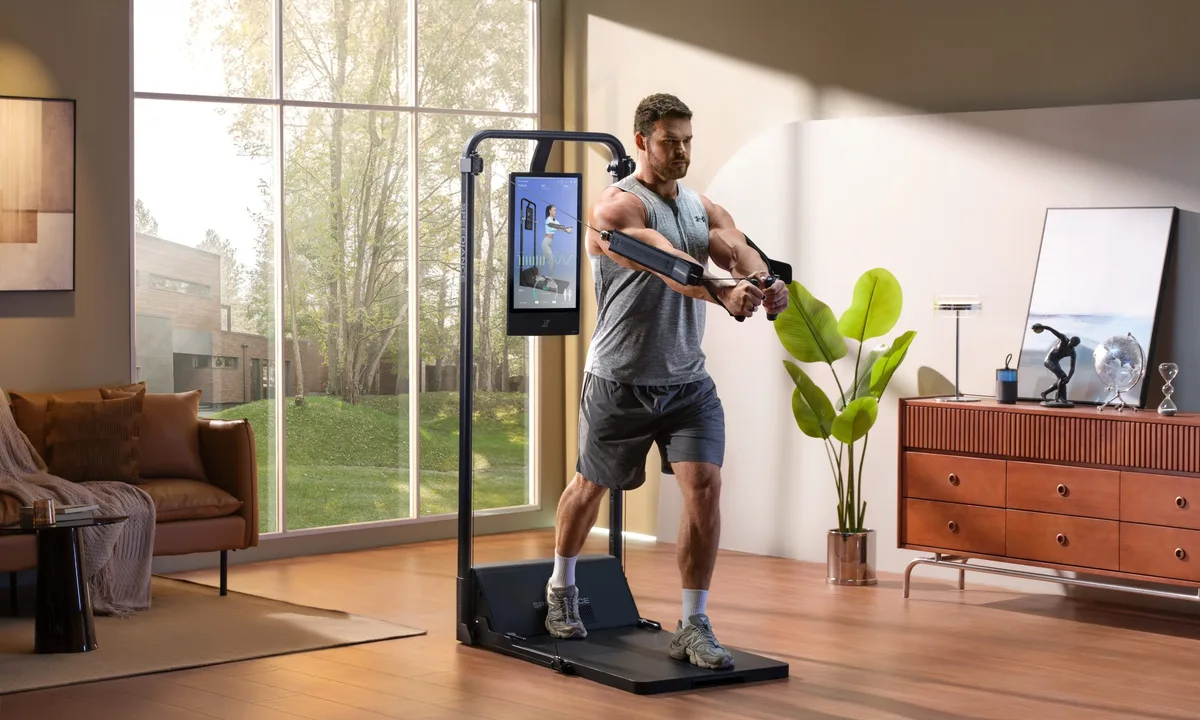
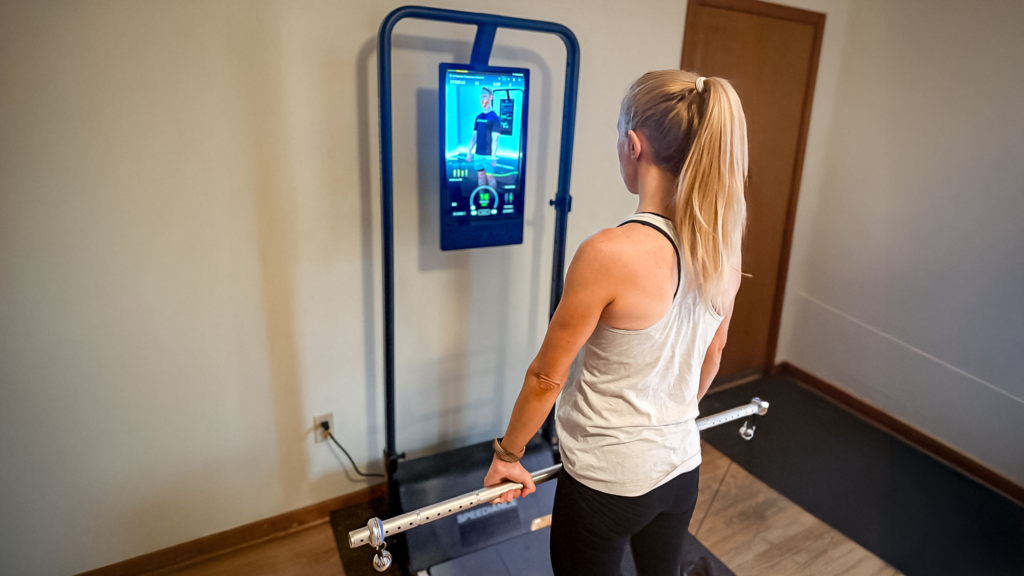
The most significant architectural decision Speediance made was to make the unit freestanding. The chassis creates an “L” shape when deployed. The vertical tower houses the motors, screen, and electronics, while a folding floor platform extends outward to serve as the user’s base.3
This platform is not merely a place to stand; it is a critical engineering component. In a wall-mounted system, the wall studs absorb the torque of the pull. In the Speediance system, the user’s own body weight acts as the counter-ballast. When you deadlift 200 pounds, you are standing on the very plate that anchors the machine. This closed-loop force vector means the machine remains incredibly stable despite being relatively lightweight compared to a functional trainer.8
| Dimension | Specification (Unfolded) | Specification (Folded) | Analysis |
| Length | 49.21 inches (1.25 m) | 14.96 inches (0.38 m) | The folded depth is remarkably slim, allowing it to sit behind doors or in corners. |
| Width | 28.34 inches (0.72 m) | 28.34 inches (0.72 m) | The width is compact, but this limits the width of the pulley stance for wide-grip movements. |
| Height | 72.83 inches (1.85 m) | 72.83 inches (1.85 m) | At roughly 6 feet tall, it fits in low-ceiling basements but limits overhead range for tall users. |
| Floor Area | ~9.68 ft² (0.89 m²) | ~3.22 ft² (0.27 m²) | The deployment ratio is nearly 3:1, maximizing efficient use of space. |
Data Sources: 3
2.2 The Frame and Pulley System
The vertical tower features a central track upon which the “slider” mechanism travels. This slider houses the two adjustable arms. On the original Gym Monster, users were limited to 10 height positions. The Gym Monster 2 improved this to 21 locking positions, dramatically increasing the biomechanical precision.8
The arms themselves are articulating robotic limbs. They can swivel vertically and rotate, allowing for a diverse range of cable angles. However, unlike a commercial dual-adjustable pulley (DAP) machine where the stacks are five feet apart, the Speediance arms originate from a central column. This narrow origin point (approx. 28 inches) has implications for exercises like chest flys. A user with a wide wingspan may find the resistance curve drops off at the top of the movement because the cables are pulling more “out” than “back”.12
2.3 The Platform and Portability
The platform is constructed to withstand high compression loads. It features a non-slip surface, crucial for generating leg drive during heavy lifts. Folding the platform is a hydraulic-assisted or spring-loaded affair (depending on the specific batch), designed to be effortless.
Despite being “portable,” the unit weighs approximately 187 lbs (85 kg).3 It sits on wheels, which theoretically allows it to be rolled away. In practice, moving a nearly 200-pound tower with a high center of gravity on carpet is a workout in itself. It is “movable” rather than “portable”—you can relocate it to clean the floor, but you wouldn’t want to move it between rooms daily.8
3. The Engine Room: PMSM Technology and Digital Resistance
To claim that the Speediance “simulates” weight is an understatement; it recreates the physics of resistance through advanced robotics.
3.1 The 800W PMSM Dual Drive
The choice of Permanent Magnet Synchronous Motors (PMSM) over induction motors is pivotal. PMSM units are favored in electric vehicles and high-precision robotics for their high torque-to-weight ratio and efficiency. In the context of a gym, this means the motor can react instantly to changes in speed and direction.3
When a user pulls the cable, the motor applies counter-torque. This is monitored thousands of times per second. If the user pulls harder (accelerating the load), the motor increases resistance to simulate the inertia of a physical mass. If the user lowers the weight, the motor carefully manages the “descent” to prevent the cable from going slack, while simultaneously acting as a generator to dissipate the energy (often as heat, managed by the cooling system).8
3.2 The Digital Weight “Feel”
Veteran lifters often ask: “Does 50 pounds feel like 50 pounds?” The answer is complex. Digital weight lacks momentum. In a barbell curl, you might use a bit of hip drive to get the weight moving, and that momentum carries the bar through the hardest part of the lift (the sticking point). With the Speediance, that momentum is mathematically cancelled out. The resistance is constant and unrelenting. As a result, 50 pounds on the Speediance often feels significantly heavier—perhaps closer to 60 or 65 pounds of free weight—because the user cannot “cheat” the physics.14
This creates a phenomenon known as “sticky weight.” During explosive movements, there can be a millisecond of lag where the motor calculates the force required. While Speediance has refined its algorithms to minimize this, some users still report a slight “unnatural” feeling compared to the crisp snap of a steel cable lifting a lead block.16 However, for controlled hypertrophy training (time under tension), this relentless resistance is arguably superior to gravity.
3.3 The Cooling Architecture
Generating resistance creates heat. The Gym Monster 2 introduced a “straight-through” airflow design to manage thermal loads better than its predecessor. The fans are active cooling components. During a heavy set of squats, the machine will emit a hum comparable to a gaming PC or a small fan. It is not silent, but it is audibly unobtrusive compared to the clanking of iron plates. This thermal management is critical; early digital gym prototypes from other brands suffered from “thermal throttling,” where the weight would drop if the motor got too hot. Speediance’s engineering appears robust in this regard, with few reports of thermal shutdown even during extended sessions.8
4. The User Experience: Interface, Audio, and Setup
The Speediance is not just a gym; it is a computer. The user interaction point is the touchscreen, which serves as the brain of the operation.
4.1 The Visual Interface
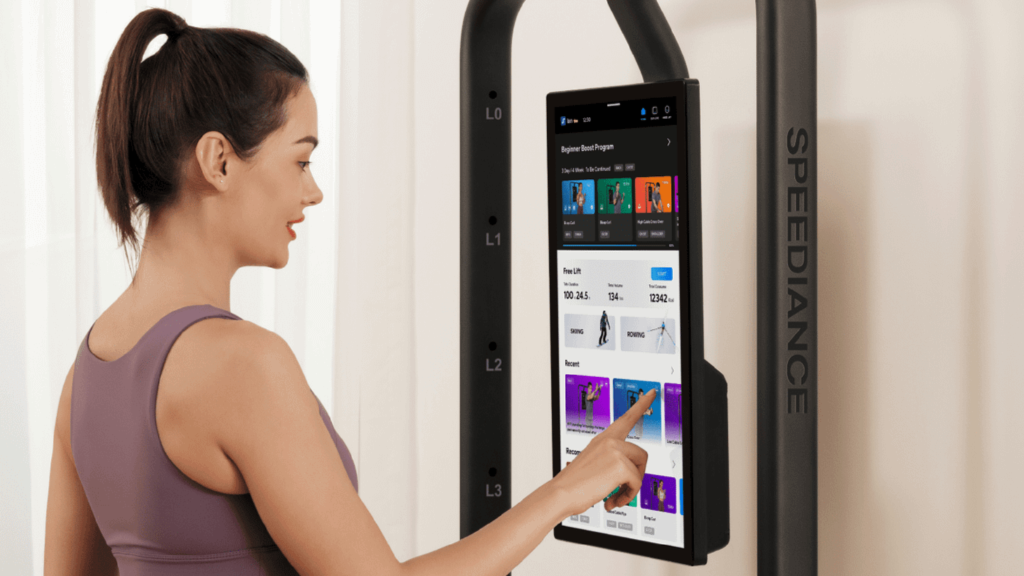
The primary interface is a 21.5-inch 1080P HD touchscreen. (Note: Some marketing materials reference a 32-inch option or future upgrade, but the standard consumer unit ships with the 21.5-inch panel).3 The screen is bright, responsive, and coated to resist sweat and fingerprints.
Crucially, the screen is mounted on the tower. In the Gym Monster 2, the screen angle is adjustable. This is a massive quality-of-life feature. When performing floor exercises like crunches or lying rows, a fixed screen would be invisible. The ability to tilt the display downwards allows the user to maintain visual contact with their metrics and the instructor without craning their neck.16
4.2 The Audio Landscape
Early iterations of home gym tech often treated audio as an afterthought, assuming users would wear headphones. The Gym Monster 2 rectified this with a 2.1 channel stereo system, comprising two 5W mid-high range speakers and a 20W subwoofer.9
While it won’t replace a dedicated Sonos system, the audio quality is surprisingly punchy. The subwoofer adds a tactile thrum to the bass during high-intensity music tracks, which can be psychologically motivating. The software supports Bluetooth 5.0, allowing users to pair their own headphones or stream their own music playlists (e.g., via Spotify integration or phone casting) directly to the machine’s speakers.3
4.3 Setup: The “No Install” Promise Verified
The delivery experience of the Speediance is distinct from Tonal. Tonal requires a logistics team to enter your home, find studs, drill holes, and mount the hardware. If you move, you must pay them to take it down.
Speediance arrives in a crate. The “setup” consists of:
- Unboxing (requires two people due to the 187lb weight).
- Rolling the unit to its location.
- Unfolding the platform.
- Plugging it in.
- Connecting to Wi-Fi.
There is no drilling, no stud-finding, and no permanency. For renters in New York, London, or Tokyo, this is the defining feature. The unit can be packed up and moved to a new apartment as easily as a refrigerator. However, users should be warned: “freestanding” does not mean “light.” Getting the crate up a flight of stairs is a significant logistical challenge that often requires a “room of choice” delivery upgrade.18
5. Training Methodologies and Software Modes
The true power of the Speediance lies not in replicating gravity, but in manipulating it. The software offers four distinct resistance modes that transform the nature of the workout.
5.1 Standard Mode: The Baseline
Standard Mode mimics the constant resistance of free weights. If you select 50 lbs, the motor provides 50 lbs of resistance on both the concentric (lifting) and eccentric (lowering) phases. This is the mode for traditional strength benchmarks. It is reliable, predictable, and the default for most users.19
5.2 Eccentric Mode: The Hypertrophy Cheat Code
Scientific literature consistently supports the idea that the eccentric phase of a lift (lowering the weight) is the primary driver of muscle hypertrophy (growth) and tendon strengthening. Humans are naturally 20-40% stronger eccentrically than concentrically. In a traditional gym, you are limited by what you can lift up. You might be able to lower 100 lbs slowly, but if you can only curl 60 lbs, you never tap into that eccentric potential.
Speediance’s Eccentric Mode automates “negative reps.” You set a “Base Weight” (e.g., 60 lbs) and an “Eccentric Enhancement” (e.g., +20 lbs).
- The Lift: You curl 60 lbs up.
- The Top: The machine instantly increases the load to 80 lbs.
- The Lower: You fight against 80 lbs on the way down.
This mode is exhausting and incredibly effective. It delivers a level of muscle stimulus that would otherwise require a workout partner to physically push down on the bar while you resist. For solo trainees, this feature alone can justify the purchase price.4
5.3 Chains Mode: Accommodating Resistance
In powerlifting, athletes use heavy steel chains draped over the barbell. As the bar is lifted, links of the chain come off the floor, making the weight heavier at the top. This matches the human strength curve; we are mechanically stronger at the lockout of a bench press than at the chest.
Speediance simulates this digitally. In Chains Mode, the resistance increases linearly as the cable is pulled further out. This allows the user to explode through the bottom of the lift and face maximum tension at the top, training explosive power and lockout strength without the noise and danger of physical chains.19
5.4 Constant Speed (Isokinetic) Mode
This mode is borrowed from advanced rehabilitation clinics. Instead of setting a weight, the user sets a speed. The machine then varies the resistance to ensure the cable moves at that exact speed, no matter how hard the user pushes.
- Rehab: A recovering patient can push gently, and the machine provides gentle resistance.
- Max Effort: An athlete can push with 100% force, and the machine will ramp up resistance to massive levels to keep the bar moving slowly. This ensures maximal muscle recruitment at every millimeter of the range of motion without the risk of momentum-based injury.19
6. The “Free Mode” Philosophy vs. Wellness+ Subscription
The battleground for the modern smart gym is the subscription model. Speediance has disrupted the market by offering a “Free Mode” that is not crippled, but the nuances are critical for a potential buyer to understand.
6.1 The “Free Mode” Reality
Unlike Tonal, which renders its screen a useless brick without a subscription, Speediance allows extensive functionality offline and unpaid.
- Free Lift: Users can access the “Free Lift” interface, where they can select any exercise, choose any mode (Standard, Eccentric, etc.), and set any weight.
- Metrics: The screen displays repetition counts, sets, and power output in real-time.
- Custom Workouts: Users can build their own routines (e.g., “Monday Chest Day”) by stringing together exercises from the library. The machine will remember the weights used previously.
- Updates: Firmware updates that improve motor algorithms are historically pushed to all users, not just subscribers.
This means that a knowledgeable lifter—someone who knows what a superset is and how to structure a program—can use the Gym Monster for a decade without paying a cent in subscription fees. This is the machine’s strongest selling point.2
6.2 The Wellness+ Subscription ($29.99/mo)
So, what does the money buy? The “Wellness+” membership is designed for the user who wants guidance, not just a tool.
- Content: Access to hundreds of instructor-led classes (video workouts similar to Peloton or Apple Fitness+).
- AI Progression: The software analyzes your performance and suggests weight increases or deload weeks automatically.
- Advanced Data: Features like “Muscle Fatigue Analysis” track which muscle groups are recovered and which are strained, helping to prevent overtraining.
- Convenience: Pre-built programs (e.g., “6-Week Shred”) that remove the cognitive load of planning workouts.
For the beginner, Wellness+ is valuable education. For the veteran, it is an optional luxury that can be ignored without losing the core utility of the machine.5
7. Accessory Ecosystem and Biomechanical Analysis
The Speediance is not just a tower; it is a platform for attachments that alter its function.
7.1 The Smart Bluetooth Ring
This small, silicone-banded controller is a stroke of genius. It wears on the index finger and features a button.
- Function: It allows the user to toggle resistance on and off remotely.
- Scenario: You are getting into position for a heavy front squat. On a traditional machine, you would have to unrack the weight and step back, risking injury. On Speediance, you step into the optimal stance, grip the bar (which has 0 lbs of resistance), sink into the squat, and then press the button. The resistance engages instantly.
- Safety: If you feel a muscle tear or get stuck, a quick tap kills the weight immediately. This functions as a digital spotter, providing immense confidence for heavy solo lifting.25
7.2 The Smart Handles and Barbell
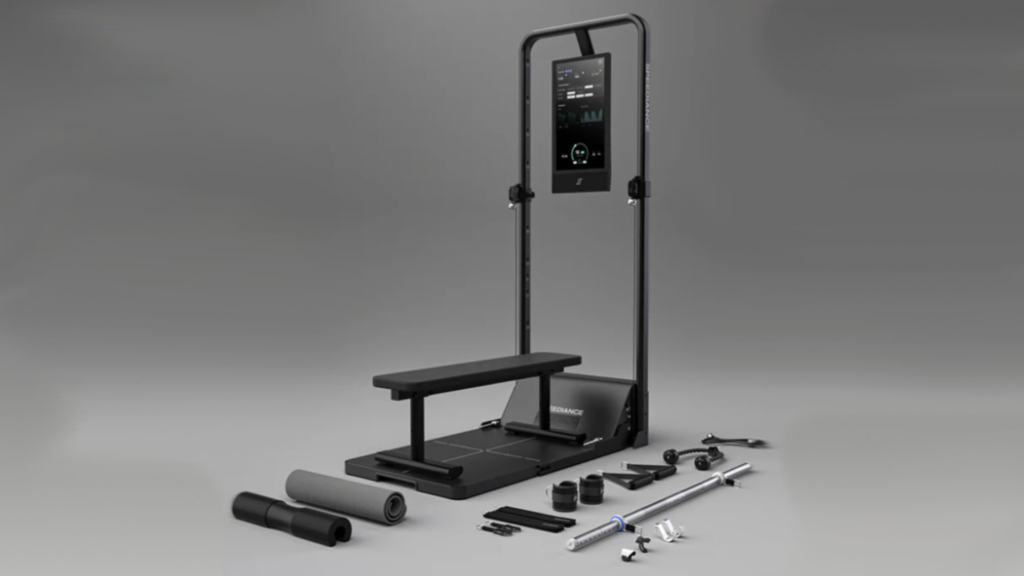
- Smart Handles: These contain sensors to track range of motion and rep completion. They are ergonomic and rotate freely.
- The Barbell: It connects to both cable arms. The digital “barbell” experience is unique. Because the cables pull independently, the bar requires more stabilization than a Smith machine but less than a free weight barbell. It forces the user to balance the left and right sides, correcting asymmetries. However, the bar is attached via carabiners, which can introduce a slight “dangling” feel compared to a rigid connection.8
7.3 The Bench Options
- Flat Bench: Included in the base “Works” package. It is sturdy but basic.
- Adjustable Bench: Included in “Works Plus.” Allows for incline and decline pressing. Crucial for upper chest development.
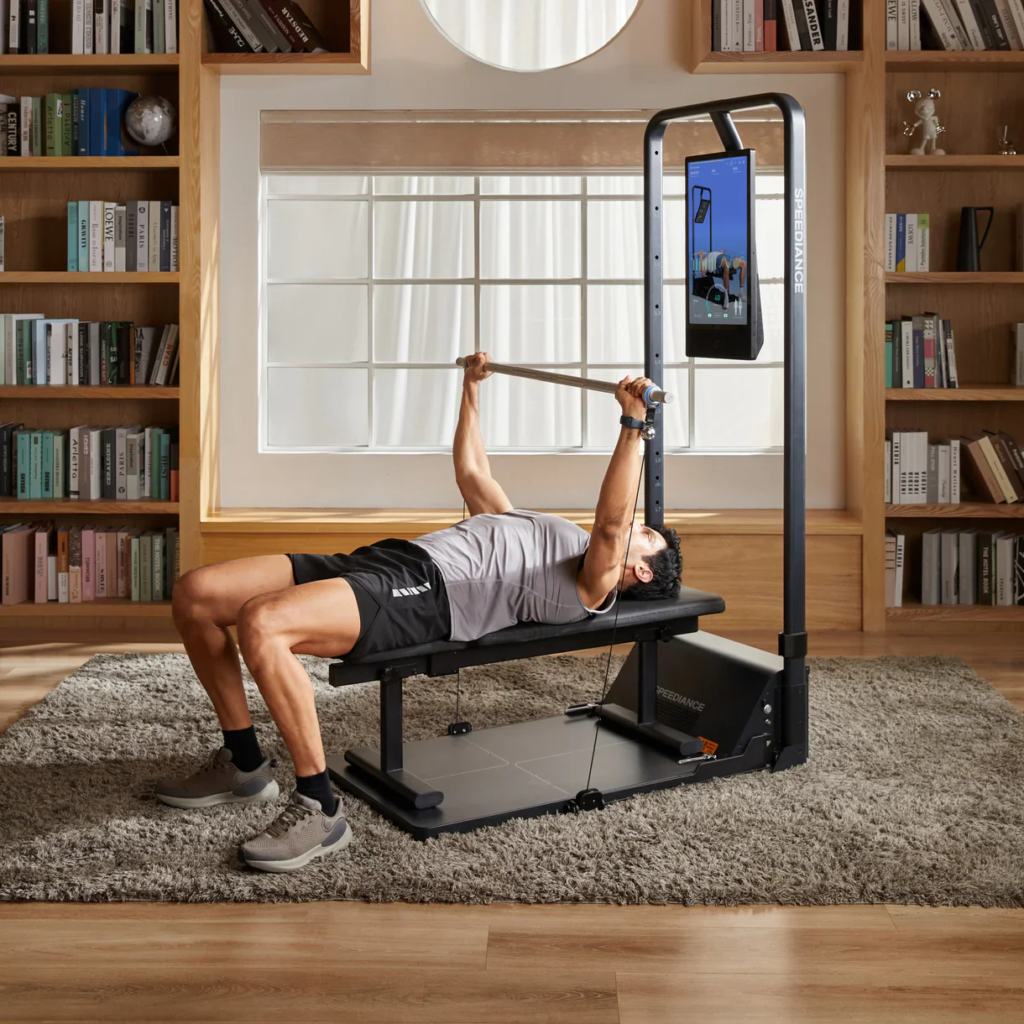
- The Issue: The benches are not locked to the machine. They sit on the floor. During heavy rowing or lateral movements, the bench can slide if not positioned on a grippy surface (like the yoga mat). The lack of a physical latching mechanism to the platform is a minor oversight compared to commercial gym benches.12
8. Real-World Performance: Strength, Cardio, and Hybrid Training
How does the Gym Monster perform in the crucible of daily training?
8.1 The “Push” Day Experience
Setting up for a bench press involves rolling the bench onto the platform. The “Spotter Mode” is the highlight here. If the machine detects the bar velocity dropping to near zero (the “struggle” phase), it automatically reduces the weight by a preset amount (e.g., 10 lbs) to allow the user to finish the rep. This eliminates the “roll of shame” associated with failing a bench press alone. The resistance is smooth, though the narrow cable origin means the cables may rub against the triceps of broad-shouldered users at the bottom of the press.12
8.2 The “Leg” Day Experience
Squatting on the Speediance is effective but has limitations.
- Height Ceiling: For users over 6’2″, standing tall with the bar on the back may hit the limit of the cable travel or the pulley height. This forces a compromise—either squatting with bent knees at the start or switching to front squats.
- Load Limit: The 220 lb (100 kg) limit is the main constraint. A dedicated lifter can squat 220 lbs relatively quickly. While Eccentric mode makes this harder, it is fundamentally a low ceiling for lower body strength. (Note: The 2S model’s increase to ~260 lbs helps, but is still not “heavy” by powerlifting standards).
- Belt Squats: The accessory “squat belt” allows users to clip the weight to their hips. This is excellent for loading the legs without compressing the spine, a movement often impossible in home gyms without specialized machines.12
8.3 The Rowing Paradox
The Gym Monster markets itself as a rower. By placing the “Rowing Bench” (a sliding seat rail) on the platform and lowering the arms, it mimics a Concept2.
- The Good: The resistance is magnetic and powerful. You can set it to drag factors impossible on air rowers.
- The Bad: It is a franken-rower. The rail is shorter than a standard rower, limiting leg extension for tall users. The setup takes 2-3 minutes—moving the bench, locking it in, changing attachments. This friction means you are unlikely to switch back and forth between rowing and lifting in a single HIIT circuit. It works best as a dedicated cardio session.8
8.4 Ski Erg
Conversely, the Ski Erg function is seamless. You simply raise the arms, grab the handles, and pull. It mimics the Concept2 SkiErg almost perfectly, providing a brutal upper-body cardio and core workout. This is one of the machine’s hidden gems.25
9. The Long Haul: Durability, Maintenance, and Warranty
Buying a $3,000+ machine requires confidence that it will last. Here, the picture is nuanced.
9.1 The Cable Vulnerability
The synthetic cables are the machine’s tires—they are consumables. Over time, friction and bending will cause them to fray.
- The Snapping Issue: Reports from the community indicate that cables can snap after 12-18 months of heavy use.
- Replacement Reality: Speediance sells replacement cables (~$50), but the replacement process is manual. It involves opening the casing, using a lighter to fuse cable ends, and threading the system. It is doable for a DIY-savvy user, but intimidating for others. This contrasts with commercial warranties that include labor.30
9.2 The Warranty Landscape
Speediance offers a split warranty:
- 2 Years: Motor, Screen, PCB, Power Supply.
- 1 Year: Accessories, Cables, Paint/Finish. The exclusion of cables from the 2-year warranty underscores their consumable nature. Users should inspect cables weekly for fraying (white fuzz) to prevent catastrophic snapping mid-lift. Extended warranties are available for purchase and are highly recommended for peace of mind.32
9.3 System Reliability
The motors and electronics appear robust. The PMSM design has fewer moving parts than brushed motors, suggesting a long service life (rated for 10,000 hours). The primary failure points reported are almost exclusively mechanical (cables, pulleys) rather than electronic.19
10. Comparative Market Analysis
To understand the Speediance’s value, we must place it against its peers.
10.1 Speediance vs. Tonal
| Feature | Speediance Gym Monster | Tonal |
| Installation | Freestanding (No Install) | Wall-Mounted (Studs Required) |
| Subscription | Optional (Free Mode) | Mandatory ($60/mo for 12 mo) |
| Max Weight | 220 lbs (100 kg) | 200 lbs (90 kg) |
| Price | ~$2,500 – $3,500 | ~$4,000 + Install + Sub |
| Arm Adjustment | Manual Sliding | Pneumatic/Lever (Easier) |
Verdict: Speediance wins on value and renter-friendliness. Tonal wins on software polish and the seamlessness of its arm adjustments.
10.2 Speediance vs. Vitruvian Trainer+
| Feature | Speediance Gym Monster | Vitruvian Trainer+ |
| Form Factor | Vertical Tower | Floor Platform Only |
| Max Weight | 220 lbs (100 kg) | 440 lbs (200 kg) |
| Exercises | Full Body (Pulldowns, etc.) | Ground-Based (Squat/DL bias) |
| Interface | Integrated Screen | Phone/Tablet Required |
Verdict: Vitruvian is the choice for serious strength athletes who need 400+ lbs of resistance. However, Vitruvian lacks the vertical tower, making lat pulldowns and tricep pushdowns difficult without buying extra tall accessories. Speediance offers a more complete “gym” experience.6
10.3 Speediance vs. Free Weights
| Feature | Speediance Gym Monster | Power Rack + Weights |
| Space | ~4 sq ft (Folded) | ~30-50 sq ft |
| Safety | Digital Spotter | Requires Human Spotter |
| Feel | Continuous Tension | Inertia/Momentum |
| Versatility | Cardio/Strength Hybrid | Strength Only |
Verdict: Free weights remain the gold standard for competitive powerlifting. For everyone else, Speediance offers 90% of the benefit in 10% of the space.
11. Financial Analysis and Value Proposition
11.1 Pricing Tiers
- Gym Monster Basic: ~$2,500. Includes unit and handles.
- Works Package: ~$3,200. Adds Flat Bench, Barbell, Accessories.
- Works Plus: ~$3,500. Adds Adjustable Bench, Rowing Bench.
- Family Plus: ~$3,800. Adds extra licenses and accessories.
Prices are approximate and subject to seasonal sales.1
11.2 ROI Calculation
A high-end gym membership (Equinox/LifeTime) costs $200/month.
- Speediance Works Package: $3,200.
- Break-even point: ~16 months. If you factor in the “Wellness+” savings (assuming you don’t pay the $60/mo Tonal fee), the savings compound significantly over 3-5 years. The lack of a mandatory subscription is the single biggest financial driver for the Speediance.1
12. Conclusion: The Verdict
The Speediance Gym Monster is not merely a piece of equipment; it is a proof of concept for a new era of fitness ownership. It successfully challenges the Silicon Valley model of “hardware as a service” by delivering a premium, intelligent strength training experience without the golden handcuffs of a subscription.
It is an engineering triumph, packing a room full of cable machines, squat racks, and cardio equipment into the footprint of a coat rack. The 800W motors deliver a resistance quality that is humbling, effective, and scientifically advanced.
However, it is not without its caveats. The cable maintenance is a reality of ownership that requires a DIY mindset. The weight limit and range of motion will frustrate the 1% of users who are exceptionally tall or exceptionally strong. But for the vast majority—the busy parent, the apartment dweller, the tech-forward lifter—the Gym Monster is arguably the most rational, versatile, and respectful investment in the smart fitness market today. It respects your space, it respects your time, and uniquely, it respects your wallet by letting you own what you buy.
In the pantheon of home gyms, the Speediance Gym Monster stands as the Unchained Titan—flawed, powerful, and delightfully free.